
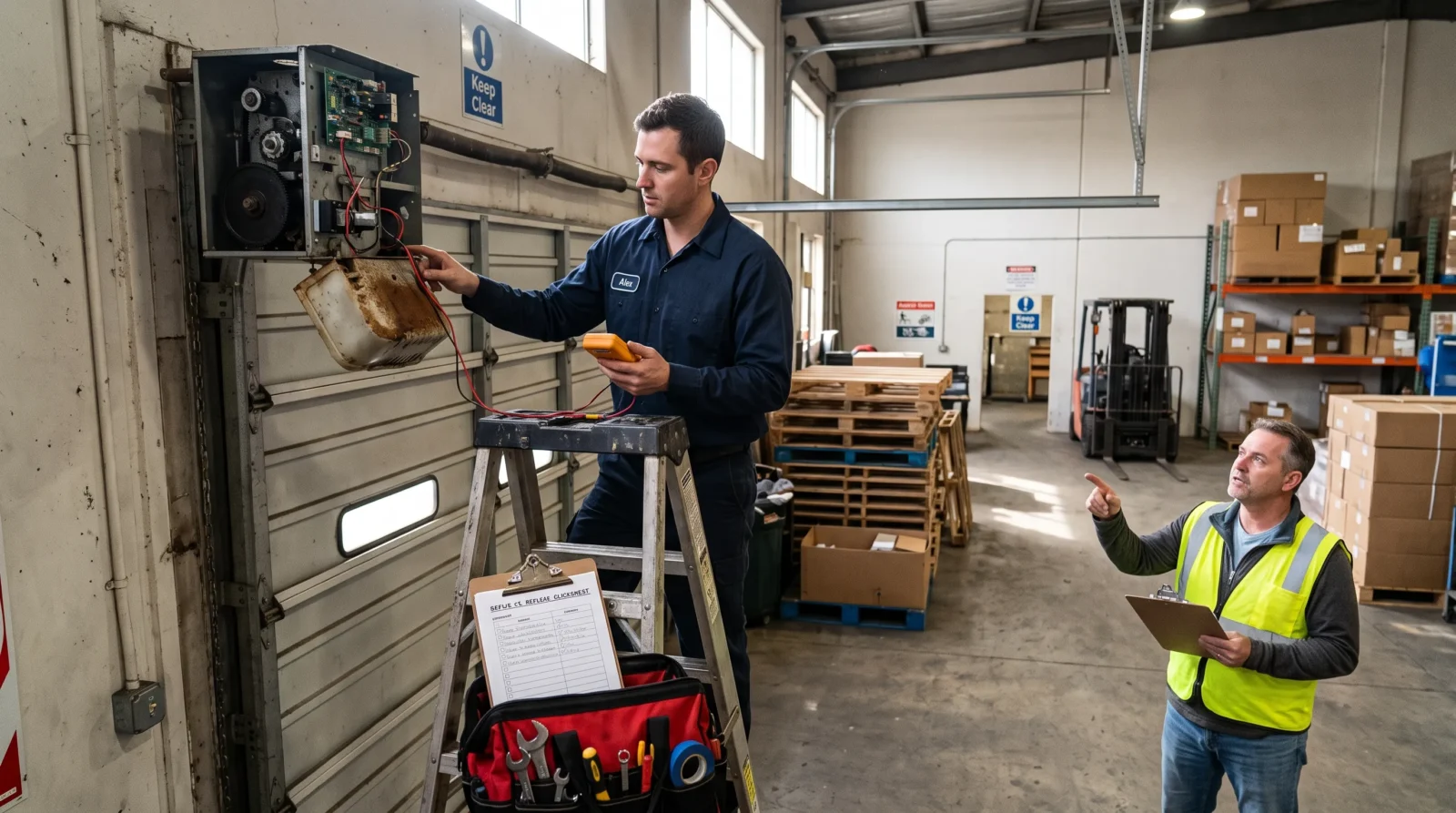
Most commercial door operators that get recommended for replacement can actually be repaired. The components that fail most often, the control board, limit switches, contactors, safety sensors, chain or belt drive and the motor brushes, are all serviceable parts. Replacement is the honest call in four situations: the control system is genuinely discontinued with no safe substitute, the operator has been rebuilt repeatedly and keeps failing, the unit is undersized for the cycle count it is actually running, or it cannot be brought into compliance with current entrapment protection requirements. If none of those four apply and you were still quoted a full replacement, ask which specific component failed. That one question resolves most of these conversations.
Key takeaways
- Ask which specific part failed and ask to see it. A diagnosis that cannot name a component is not a diagnosis.
- Repair frequency matters far more than age. A ten-year-old operator serviced twice is worth repairing. A four-year-old unit on its fourth call this year is telling you something else.
- A struggling operator is often a counterbalance problem, not an operator problem. Replacing the motor will not fix a door the springs are no longer helping to lift.
- Get the make, model and serial number off the data plate before any conversation about replacement, and photograph it.
- Replacement is legitimate for discontinued controls, repeated rebuilds, duty cycle mismatch, or safety compliance that cannot be met.
- Get both options quoted in writing. A contractor who will only quote replacement has made the decision for you.
Operator replacement is one of the largest single line items in commercial door service, which is exactly why it attracts pressure. The six signs below are ordered by how often they show up, starting with the most common.
1. The diagnosis arrived in under ten minutes with no testing
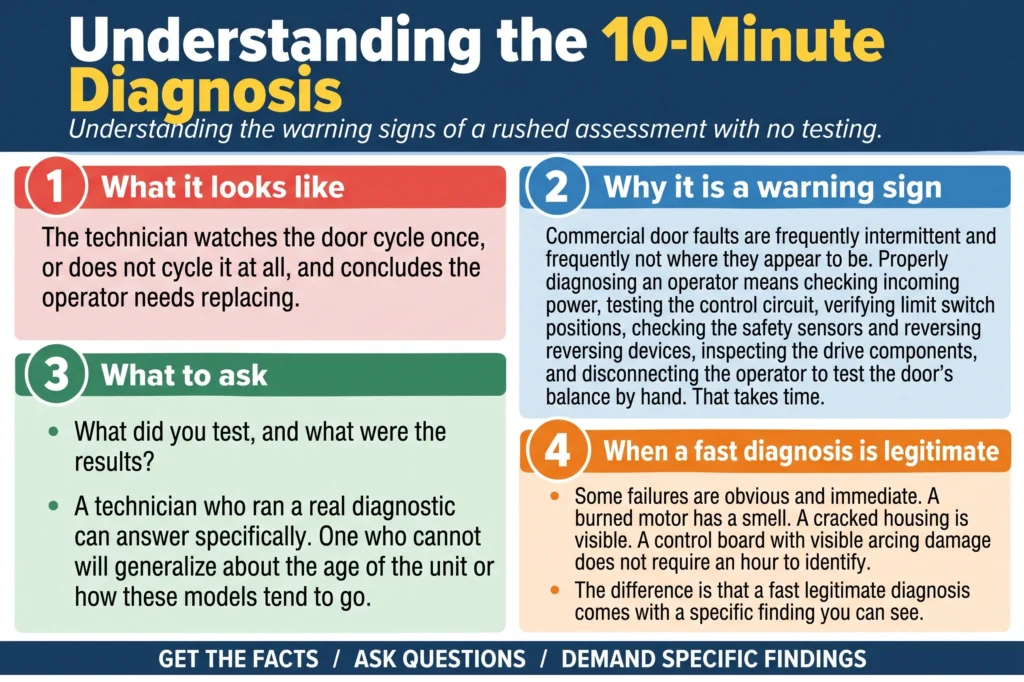
What it looks like: the technician watches the door cycle once, or does not cycle it at all, and concludes the operator needs replacing.
Why it is a warning sign: commercial door faults are frequently intermittent and frequently not where they appear to be. Properly diagnosing an operator means checking incoming power, testing the control circuit, verifying limit switch positions, checking the safety sensors and reversing devices, inspecting the drive components, and disconnecting the operator to test the door’s balance by hand. That takes time.
What to ask: what did you test, and what were the results. A technician who ran a real diagnostic can answer specifically. One who cannot will generalize about the age of the unit or how these models tend to go.
When a fast diagnosis is legitimate: some failures are obvious and immediate. A burned motor has a smell. A cracked housing is visible. A control board with visible arcing damage does not require an hour to identify. The difference is that a fast legitimate diagnosis comes with a specific finding you can see.
How a commercial door operator should actually be diagnosed
The most important step is the one most often skipped: disconnecting the operator and moving the door manually to check its balance. A properly counterbalanced door should move with moderate effort and stay roughly in place when stopped partway. If it slams down or fights you, the problem is in the counterbalance system, not the motor. Understanding how the emergency release on a commercial overhead door works is relevant here, because that disconnect is the mechanism the test relies on.
2. Nobody can name the failed component
What it looks like: the explanation stays at the level of the whole unit. The operator is worn out, it is at the end of its life, it is not worth fixing.
Why it is a warning sign: commercial operators are assemblies of serviceable parts. Boards, contactors, limit switches, photo eyes, sprockets, chains, belts, brushes and bearings all fail individually and are all replaceable individually. A diagnosis that never descends to the component level is usually a diagnosis that was never performed.
What to ask: which part failed, can I see it, and is it available separately. Ask for the finding in writing. A legitimate technician will show you the component and explain what it does.
When a whole-unit answer is legitimate: occasionally multiple systems have failed at once, typically after water intrusion, a lightning event or an impact. In those cases the technician can still name what failed, plural, and explain why piecemeal repair does not make sense.
Which commercial door operator parts can be replaced individually
Nearly all of them. Control boards, logic modules, contactors and relays, limit switches and travel encoders, photo eyes and safety edges, motors and brushes, gearboxes, sprockets, chains, belts, and clutch assemblies are all standard serviceable items on a commercial motor operator. If your quote skipped straight past all of them, ask why.
3. Parts are “no longer available” and nobody checked the model number
What it looks like: the technician says parts are discontinued for your brand or that the unit is too old to service, without ever reading the data plate.
Why it is a warning sign: most facility managers cannot independently verify parts availability, which makes this the easiest claim in the trade to make and the hardest to check on the spot. Manufacturer support for commercial equipment often runs far longer than people expect, and aftermarket components frequently exist where original parts do not.
What to ask: for the make, model and serial number, and what specifically they tried to source. Photograph the data plate yourself. Then verify parts availability with the manufacturer or a second contractor before accepting the diagnosis.
When obsolescence is real: it does happen, particularly with older logic controls where boards are out of production and no validated substitute exists. A contractor making this claim honestly can name the manufacturer, the discontinued part, and the channels they checked.
How to check if commercial door operator parts are really discontinued
Photograph the data plate before anything is removed. Make, model and serial number are all you need to check support directly with the manufacturer, and once equipment is off the wall, verifying the claim becomes much harder. Manufacturer guidance such as Clopay’s advice on avoiding door repair scams describes this same pattern, and the verification step is straightforward.
4. Age is the entire argument
What it looks like: the unit is fifteen years old, so it needs replacing. No other reasoning is offered.
Why it is a warning sign: age correlates poorly with condition on commercial equipment. A well-specified operator on a low-cycle door in a clean environment can run for decades. An undersized unit on a high-cycle dock opening in a dusty warehouse can be finished in five years. What matters is cycle count, duty rating, environment and service history, not the year on the plate.
What to ask: how many cycles a day the door runs, what the operator’s duty rating is, and how many service calls it has generated in the past two years. Those three numbers tell you far more than age does.
When age is a legitimate factor: age matters when it brings other things with it, specifically discontinued parts support and safety standards that have moved on. Age alone is not the argument. Age plus a documented consequence is.
Does a commercial door operator need replacing because of age
Not on its own. The useful metric is repair frequency against replacement cost. If an operator has needed three or four service calls in twelve months for different faults, the cumulative spend is approaching replacement territory and the equipment is signaling something. If it has run for a decade with routine service, its age is evidence that it was specified correctly, not evidence that it is finished.
5. Only one option was quoted
What it looks like: the quote covers replacement. There is no repair option, no cost comparison, and no discussion of what repair would involve.
Why it is a warning sign: an honest contractor quotes both when both are viable, explains the tradeoff, and lets you decide. Presenting a single option removes the comparison that would reveal whether replacement was necessary.
What to ask: for a repair quote alongside the replacement quote, with the expected life of the repair stated. If the answer is that repair is not viable, ask why, in writing, with the specific component named.
When a single option is legitimate: when repair genuinely is not viable, which the contractor should be able to explain in one or two specific sentences. Even then, most established companies still document why repair was ruled out, because their commercial clients ask.
Should a commercial door contractor quote both repair and replacement
Yes, whenever both are technically possible. The comparison should include the repair cost, the replacement cost, what the repair is expected to buy you in service life, and whether the existing unit is correctly sized for the door’s actual duty. Anything less is asking you to make a capital decision without the information. This is the same documentation problem that drives most billing disputes, covered in Why Was My Commercial Door Repair Bill So High? 7 Charges Worth Questioning.
6. You are pushed to decide immediately
What it looks like: the price expires today, the unit is the last one available, or financing is pressed hard before you have understood the diagnosis.
Why it is a warning sign: urgency exists to prevent comparison. Every hour you spend getting a second opinion is an hour the recommendation can be checked.
What to ask: for the diagnosis in writing, then take it to a second contractor. Replacement of a commercial door operator is a capital expense on most facility budgets, and capital expenses warrant a second quote as a matter of normal practice, not suspicion.
When urgency is real: a door that cannot be secured overnight, a fire-rated assembly that has failed, or a dock opening blocking outbound freight are all genuinely time-critical. The right response is to authorize the minimum work needed to make the opening safe or secure, then decide on replacement without pressure. The International Door Association’s scam awareness guidance documents manufactured urgency as one of the most consistent features of contractor fraud across markets.
When repair makes sense, and when replacement is the honest call
Situation | Usually repair | Usually replace |
A single named component failed | Yes | No |
Control board, contactor or limit switch fault | Yes | No |
Safety sensors or reversing device failure | Yes | No |
Chain, belt, sprocket or bearing wear | Yes | No |
Door is hard to move by hand with operator disconnected | Neither, this is a counterbalance issue | No |
Operator serviced twice in ten years | Yes | No |
Three or more different faults in twelve months | Consider replacement | Likely |
Control system discontinued, no validated substitute | No | Yes |
Operator undersized for actual daily cycle count | No | Yes |
Cannot meet current entrapment protection requirements | No | Yes |
Motor burned with housing or gearbox damage | Rarely | Yes |
Water intrusion or lightning damage across multiple systems | No | Yes |
One safety rule sits above all of this. Do not work on counterbalance springs or lift cables on any commercial door under any circumstances, and do not disable a safety sensor to keep an opening running through a shift. If a door is failing its safety functions, take it out of service until it is repaired. Improper manual operation causes its own damage, and using the emergency release incorrectly can damage a commercial overhead door in ways that later get attributed to the operator.
Ask which part failed, then decide
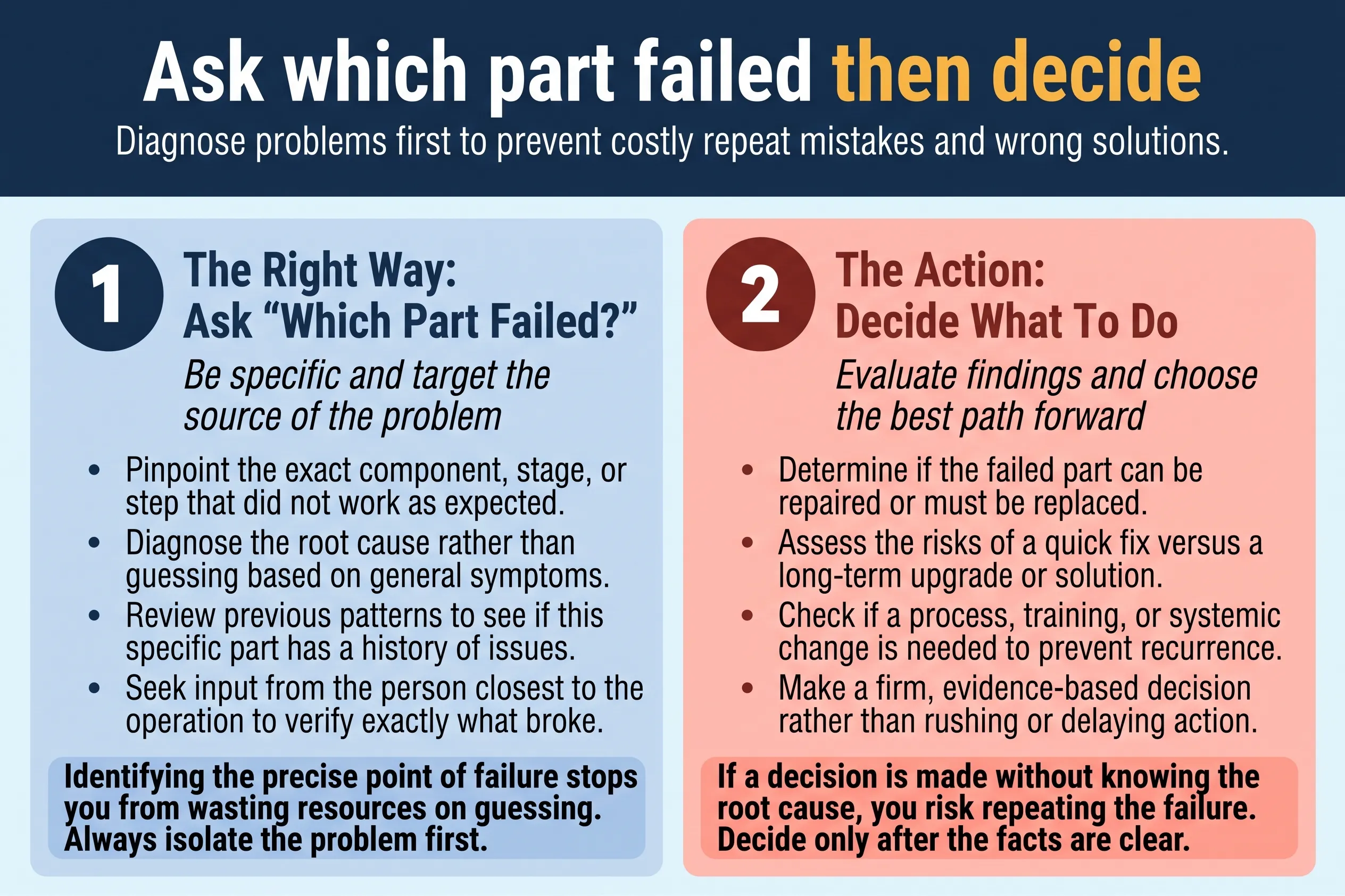
Almost every unnecessary operator replacement traces back to a diagnosis nobody questioned. The single most effective thing a property manager can do is ask which component failed and ask to see it. A technician who did the work answers easily. One who did not will move to generalities about age and wear, and that shift in register is the tell.
Then get both options in writing, with the repair’s expected service life stated, and take any capital-level recommendation to a second contractor. That is normal commercial practice, not an accusation.
It is also worth separating the operator from everything around it. A commercial overhead door that binds, drags or reverses may be presenting an operator symptom caused by track, counterbalance or alignment problems, and replacing the motor will not solve any of them. If the door will not open even with the emergency release, that points away from the operator entirely. Where an opening is tied into building security, replacement also has downstream effects, since access control connects individual doors to site-wide control and a new operator has to integrate with what is already there. Getting this right matters operationally as much as financially, because reliable rolling doors directly support business operations.
For the wider pattern these six signs belong to, see How to Avoid Commercial Door Repair Scams. If the contractor who made the recommendation is one you have not vetted, start with How Do I Know If a Commercial Door Company Is Legit? 8 Things to Check Before You Call. Industry groups continue to track these tactics, and current alerts from the International Door Association reflect how widely they persist. A scheduled commercial door service program is the most reliable defense, because equipment on a documented service history rarely produces a surprise replacement recommendation.
If you manage a commercial property in Central Texas and want a contractor who names the failed component, quotes repair and replacement side by side, and repairs when repair is viable, R&S Overhead Garage Door of Texas, Inc. serves Travis, Hays, Burnet and Bastrop counties with licensed technicians and locally stocked parts.
Request a free written quote for your commercial door service and get both options priced before you commit to either.