
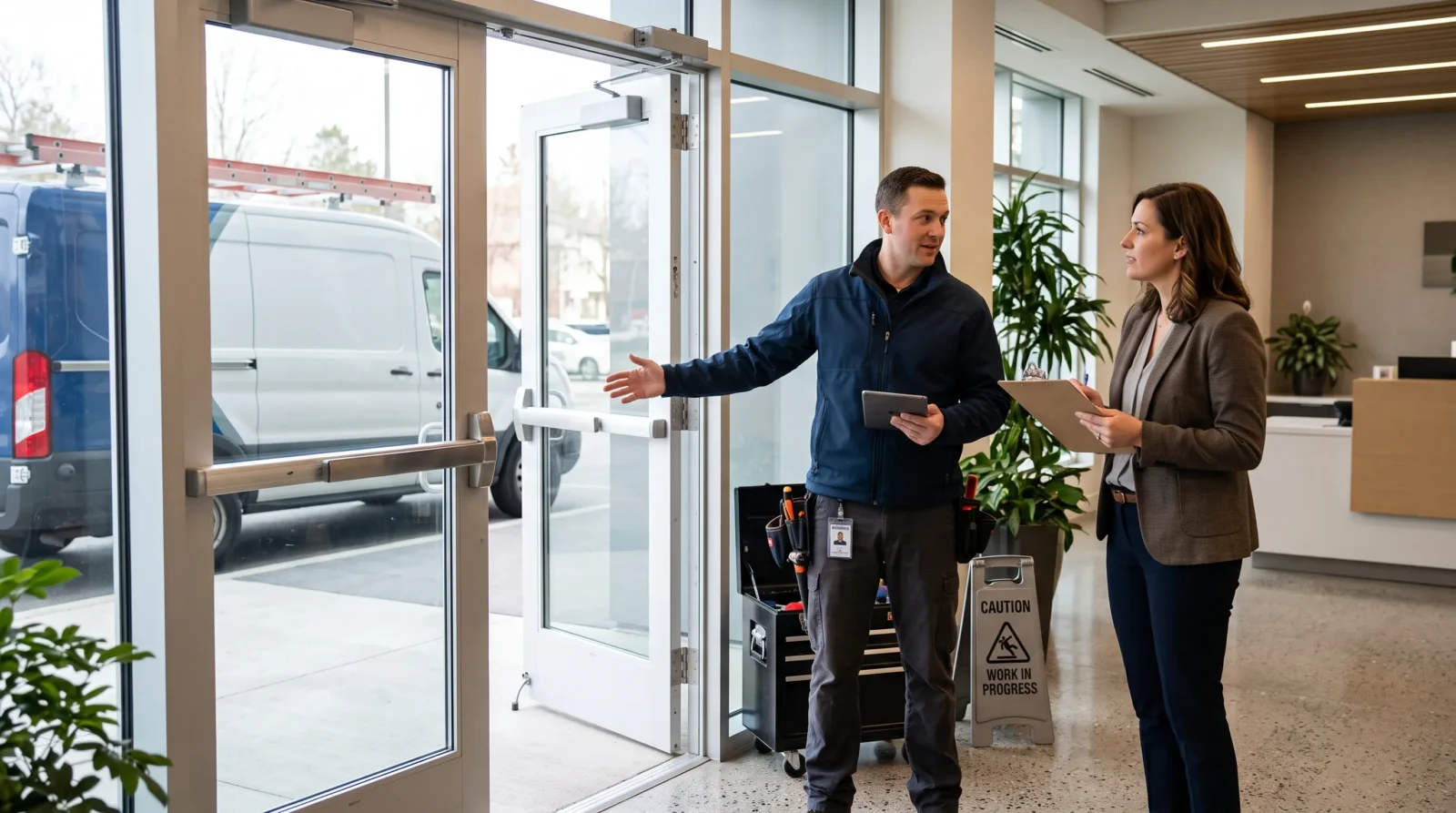
A commercial door company is legitimate if it can produce four things on request: a license or registration number, a current certificate of insurance naming general liability and workers’ compensation, a verifiable physical business address, and a written quote before any work begins. All four can be confirmed in about fifteen minutes, before a truck ever reaches your property. A company that hesitates on any of them should not be on your site. The most reliable single test is the certificate of insurance, because fraudulent operators can fake a website and a phone number far more easily than an active insurance policy.
Key takeaways
- Verify four things before scheduling: license or registration, certificate of insurance, physical address, and a written quote policy.
- Request the certificate of insurance directly from the insurer or agent listed on it, not just as a PDF from the contractor.
- A physical address that turns out to be a mail drop, a virtual office or a residential lot is the most common tell in contractor fraud.
- Ask whether the company’s own employees do the work or whether it is subcontracted, and get that answer before booking.
- Commercial experience is not the same as residential experience. Ask specifically about the door type you have, whether that is a rolling door, sectional, high speed or fire-rated assembly.
- Fifteen minutes of verification prevents the large majority of problems. Almost nothing else in facility management has that return.
Property managers and business owners get targeted for a reason. Commercial work is high value, decisions are often made under downtime pressure, and invoices frequently pass through accounts payable rather than the person who watched the work happen. The eight checks below are ordered by how much they actually filter out, starting with the ones that catch the most.
1. Verify the license or registration number
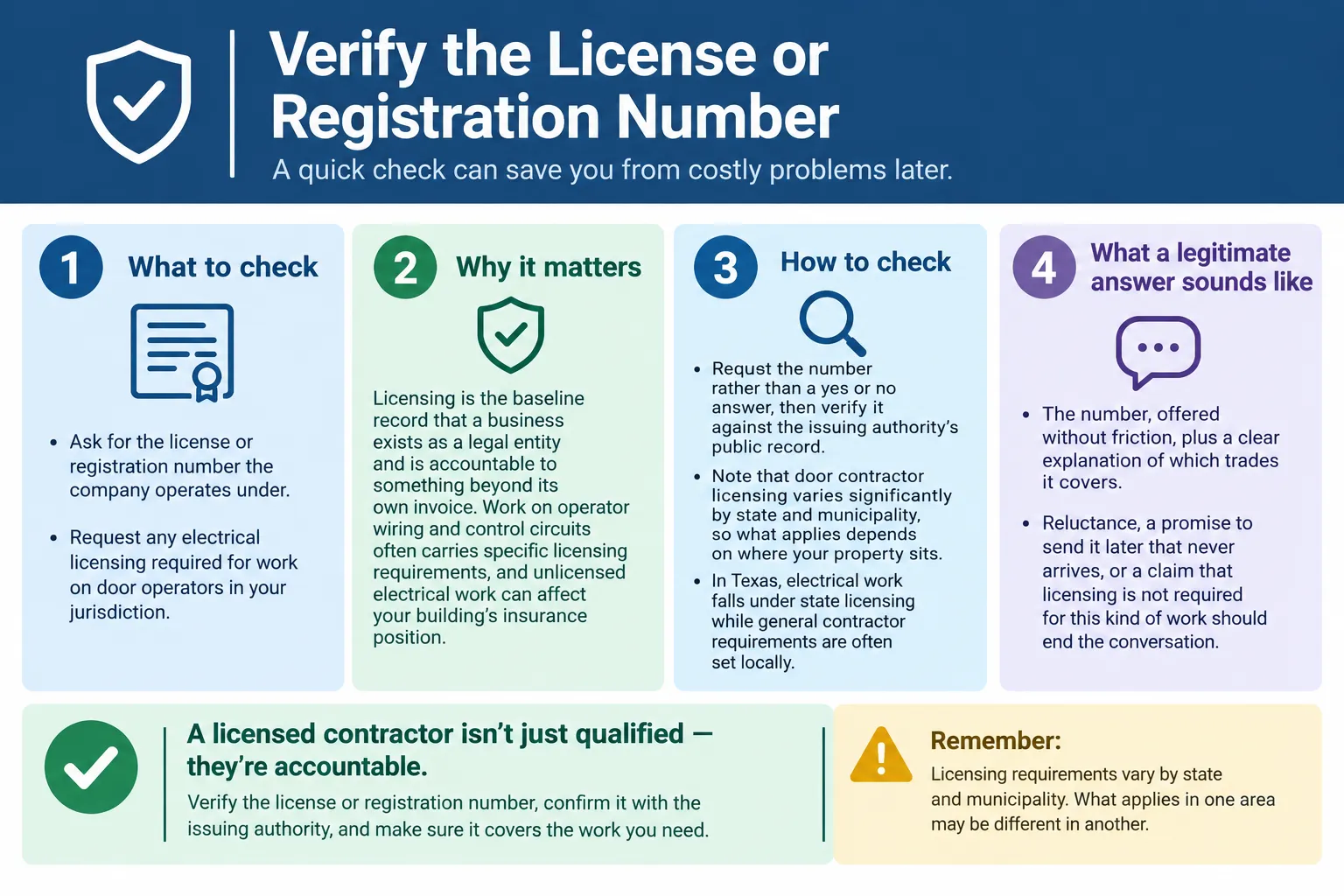
What to check: ask for the license or registration number the company operates under, and any electrical licensing required for work on door operators in your jurisdiction.
Why it matters: licensing is the baseline record that a business exists as a legal entity and is accountable to something beyond its own invoice. Work on operator wiring and control circuits often carries specific licensing requirements, and unlicensed electrical work can affect your building’s insurance position.
How to check it: request the number rather than a yes or no answer, then verify it against the issuing authority’s public record. Note that door contractor licensing varies significantly by state and municipality, so what applies depends on where your property sits. In Texas, electrical work falls under state licensing while general contractor requirements are often set locally.
What a legitimate answer sounds like: the number, offered without friction, plus a clear explanation of which trades it covers. Reluctance, a promise to send it later that never arrives, or a claim that licensing is not required for this kind of work should end the conversation.
How to verify a commercial door contractor’s license before hiring
Ask for the number in writing, ideally by email, so you have a record of what was claimed. Then check it independently. A contractor who provides a number that does not match the business name on their invoice is a serious problem, and it is more common than most facility managers expect.
2. Request a current certificate of insurance
What to check: a certificate of insurance showing general liability and workers’ compensation coverage, with current effective dates.
Why it matters: this is the single highest-value check on the list. If an uninsured worker is injured on your property, or damages your building or inventory, the exposure can land on you or your carrier. For commercial property, this is not a formality.
How to check it: ask for the certificate to be sent by the insurance agent or broker listed on it, not forwarded as a PDF by the contractor. Certificates are trivially easy to alter. Confirm the policy is active, the dates cover your service window, and the named insured matches the company you are hiring. Many property managers also require being named as an additional insured, which is a reasonable request on larger scopes.
What a legitimate answer sounds like: an agent’s contact information provided immediately, because established contractors handle this request constantly. Any version of “we’re covered, don’t worry about it” is a refusal.
Why commercial door contractor insurance matters more than price
The cheapest quote frequently comes from the contractor carrying the least coverage, because insurance is a real and substantial cost of operating legitimately. When a bid comes in dramatically below the others, insurance is one of the first places to look for the explanation. The International Door Association’s scam awareness resources document how fraudulent operators build convincing fronts, and thin or absent coverage is a consistent thread.
3. Confirm a real physical business address
What to check: a street address that corresponds to an actual facility, ideally with parts inventory and service vehicles.
Why it matters: some operations advertise across dozens of markets with no presence in any of them, collecting calls and dispatching whoever is available. Nobody involved has a stake in your building or an incentive to be reachable in six months.
How to check it: search the address. Look at satellite and street-level imagery. A legitimate commercial door contractor occupies a warehouse or service facility, not a UPS Store suite number or a house in a subdivision. Ask how long they have operated at that location and how far it is from your property.
What a legitimate answer sounds like: a specific address, a straightforward answer about how long they have been there, and no discomfort with you visiting. Vagueness about location, or an address that resolves to a mailbox service, is among the clearest signals in contractor fraud.
How to spot a fake local commercial door company
The pattern is consistent: a generic business name, stock photography, a local-sounding phone number that forwards elsewhere, and an address that does not survive thirty seconds of searching. Local presence also has a practical benefit beyond legitimacy, since a nearby facility means stocked parts, which is often the difference between same-day service and a week of downtime.
4. Ask about manufacturer authorization and the brands they service
What to check: which manufacturers the company is authorized to service, and whether that includes the equipment actually installed at your property.
Why it matters: manufacturer authorization means factory training, warranty standing and access to genuine parts. Without it, warranty work on your equipment may not be honored, and parts may be substituted with components that were never validated for your assembly.
How to check it: pull the make and model off the data plate on your door or operator before you call, then ask directly whether they are authorized for that brand. Ask what they stock locally for it. If your building runs a commercial motor operator on a high-cycle opening, parts availability is the difference between a short repair and an extended outage.
What a legitimate answer sounds like: specific brand names, and honesty when a brand falls outside their authorization. A contractor who claims to be authorized for every manufacturer in the industry is overstating it.
Why manufacturer authorization matters for commercial door repair
Authorization also affects what happens when a repair does not hold. An authorized servicer has a channel back to the manufacturer for defective components and technical support on unusual faults. An unauthorized one has your invoice and nothing else.
5. Find out who will actually perform the work
What to check: whether the company’s own employees do the work, or whether it is routed to a subcontractor.
Why it matters: subcontracting is not inherently a problem, and many legitimate companies use subcontractors for specialty scopes. The problem is undisclosed subcontracting, where the insurance you verified, the license you checked and the warranty you were promised all belong to a company that is not the one on your roof.
How to check it: ask plainly. If subcontractors are used, ask whether they carry their own coverage and who honors the warranty. Get the answer in writing on the quote.
What a legitimate answer sounds like: direct disclosure. Established contractors answer this without hesitation because they have a defined policy. Evasion here usually means the answer is one you would not like.
Should a commercial door company use subcontractors
The workable rule is disclosure, not prohibition. A contractor who tells you upfront that a specialty scope, for instance a fire-rated assembly or a high-speed door, goes to a specialist partner, and who stands behind the warranty regardless, is operating normally. A contractor who lets you assume it is their crew is not.
6. Confirm they actually do commercial work
What to check: whether commercial doors are a core business or an occasional sideline to residential work.
Why it matters: commercial doors are a different discipline. Rolling steel doors, sectional overhead doors, high speed doors, dock equipment and fire-rated assemblies have different failure modes, different code requirements and different safety systems than residential equipment. A technician whose experience is residential may misdiagnose a commercial fault entirely.
How to check it: ask what percentage of their work is commercial, name your specific door type, and ask what comparable facilities they serve. For a commercial overhead door on a distribution facility, you want a contractor who talks about cycle counts and duty ratings, not one who reaches for residential equivalents.
What a legitimate answer sounds like: fluent, specific detail about your door type. If you describe a rolling steel door and the response is about springs and openers in residential terms, you have your answer.
What commercial door experience should a contractor have
Fire-rated doors deserve particular attention. They require documented drop testing on a defined schedule, and a contractor who cannot speak to that requirement should not be servicing them. The same applies to any door integrated with building access systems, where the door and the access control planning for the property have to work as one system.
7. Look for reviews with specifics, and ask for real references
What to check: reviews that describe actual jobs, and references from facilities comparable to yours.
Why it matters: volume of reviews means less than texture. Fabricated reviews are generic and enthusiastic. Real ones mention the door type, the problem, the timeline and often the technician’s name.
How to check it: read the three-star reviews first, since they tend to be the most honest. Then ask for two or three references from properties similar in type and size to yours, and actually call them. Ask about response time, whether the quote matched the invoice, and whether the repair held.
What a legitimate answer sounds like: references provided without stalling. A contractor with a real service history in your area has clients who will speak for them.
How to check commercial door company reviews for red flags
Watch for a sudden cluster of five-star reviews in a short window, reviews with no job detail, and reviewers with no other review history. Also check whether the reviews describe commercial work at all. A page full of residential praise tells you little about how a contractor handles a dock door.
8. Require a written quote before dispatch
What to check: the company’s policy on written, itemized quotes, and whether work proceeds without written approval.
Why it matters: nearly every commercial door billing dispute traces back to work performed on a verbal understanding. A written scope establishes what was agreed before the leverage shifts, which happens the moment your door is disassembled.
How to check it: ask directly whether you will receive an itemized written quote, whether it separates parts, labor and any trip or after-hours charge, and whether work stops for written approval if the scope changes on site. Ask what their warranty covers and for how long, in writing.
What a legitimate answer sounds like: a clear yes, and usually a description of their process. Companies running an ongoing commercial door service program tend to have this formalized already.
What should be included in a commercial door repair quote
At minimum: itemized parts, labor, any trip or dispatch charge, after-hours or emergency rates if they apply, freight on special-order components, disposal, and the warranty terms for parts and labor stated separately. If the quote is a single number with no breakdown, ask for it again. The specific charges most often disputed are covered in Why Was My Commercial Door Repair Bill So High? 7 Charges Worth Questioning.
Legitimate answers versus warning signs
Use this as a phone script. Ask the question in the left column and compare what you hear.
What you ask | Legitimate answer | Warning sign |
“What is your license or registration number?” | Provides it immediately, explains what it covers | Deflects, promises to send it, says it is not required |
“Can your agent send a certificate of insurance?” | Gives agent contact info without hesitation | Sends only a PDF, or says coverage is not a concern |
“What is your physical address?” | A real facility, no discomfort with a visit | Mailbox suite, residential lot, vague on location |
“Which manufacturers are you authorized for?” | Names specific brands, admits gaps | Claims authorization for every brand |
“Will your employees do the work?” | Direct answer, discloses any subcontracting | Avoids the question |
“What share of your work is commercial?” | Specific figure, fluent on your door type | Answers in residential terms |
“Can I have two references from similar facilities?” | Provides them promptly | Stalls or refuses |
“Will I get an itemized written quote first?” | Yes, with a described process | “We’ll figure it out on site” |
“What does your warranty cover, in writing?” | Parts and labor periods stated separately | Verbal only, or shifts between conversations |
Two notes on using this. You do not need a perfect score on all nine rows, but the first two are not negotiable for commercial property. And if a contractor becomes irritated by the questions, that reaction is itself information. Established companies field these calls constantly.
Fifteen minutes now, or a dispute later
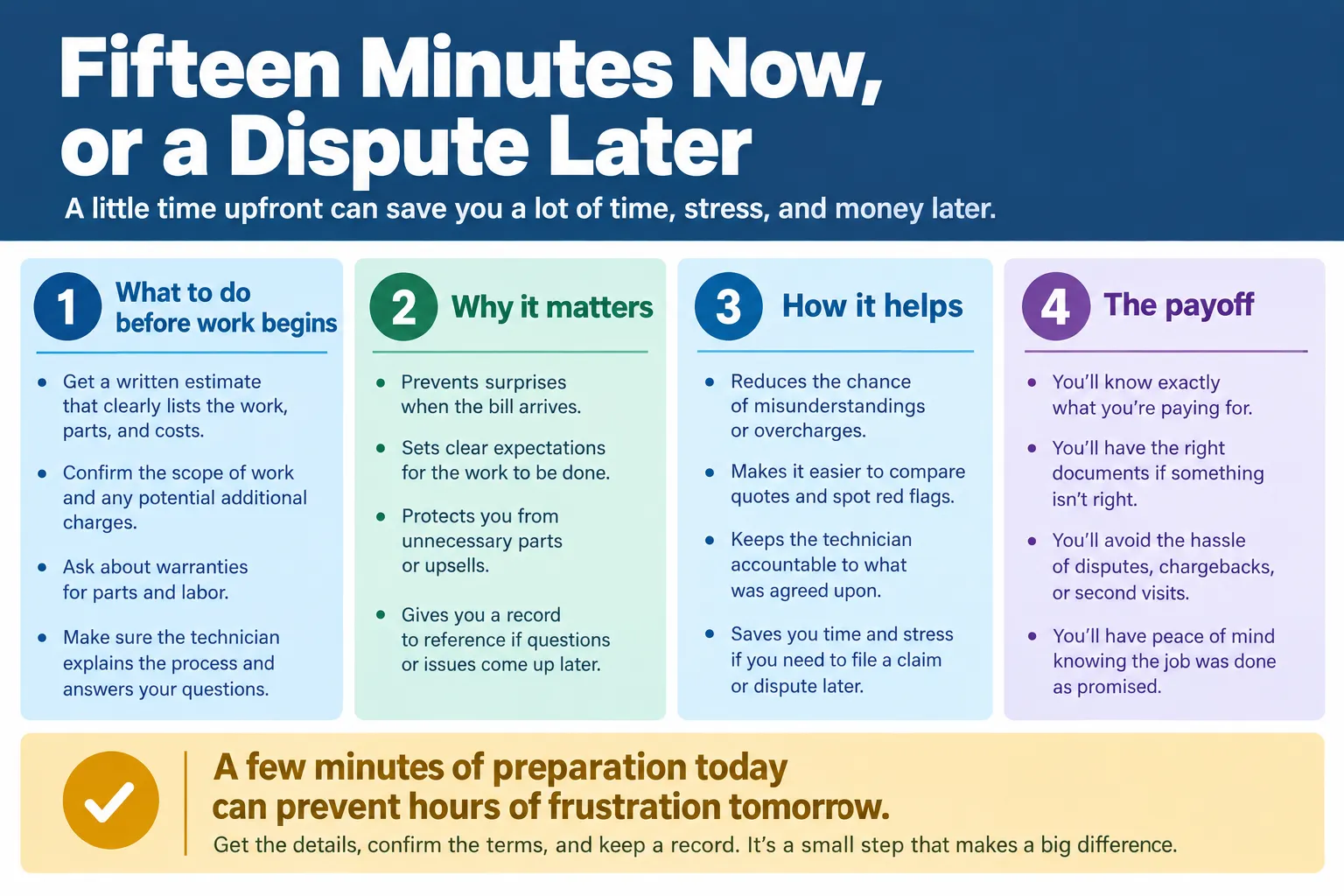
Vetting a contractor is not an investigation. It is four verifications and a handful of questions, and it can be done before anyone drives to your property. The contractors who resist it are, with striking consistency, the ones you would have had a problem with.
This check matters most before an emergency, not during one. When a door fails and freight is waiting, nobody runs a certificate of insurance. That is exactly why businesses need a commercial door repair relationship established in advance rather than sourced under pressure, and why unplanned failures affect daily operations far beyond the repair cost itself. If you are still deciding whether a given issue warrants a professional at all, the signs you need to hire a pro for commercial door repair are a useful starting point. For the wider set of tactics these checks are designed to catch, see How to Avoid Commercial Door Repair Scams. One tactic worth knowing in advance is the pressure to replace equipment that could be repaired, covered in Should I Repair or Replace My Commercial Door Operator? 6 Signs You’re Being Upsold.
Industry groups have tracked these schemes for years. Recent warnings from the International Door Association and Clopay’s guidance on spotting door repair scams both describe the same patterns showing up across markets, which is a reasonable indication of how persistent they are.
If you manage a commercial property in Central Texas and want a contractor who provides license and insurance documentation on request, quotes in writing, and staffs its own licensed technicians, R&S Overhead Garage Door of Texas, Inc. serves Travis, Hays, Burnet and Bastrop counties from a local facility with stocked inventory.
Request a free written quote for your commercial door service and get documentation and an itemized scope before any work begins.