
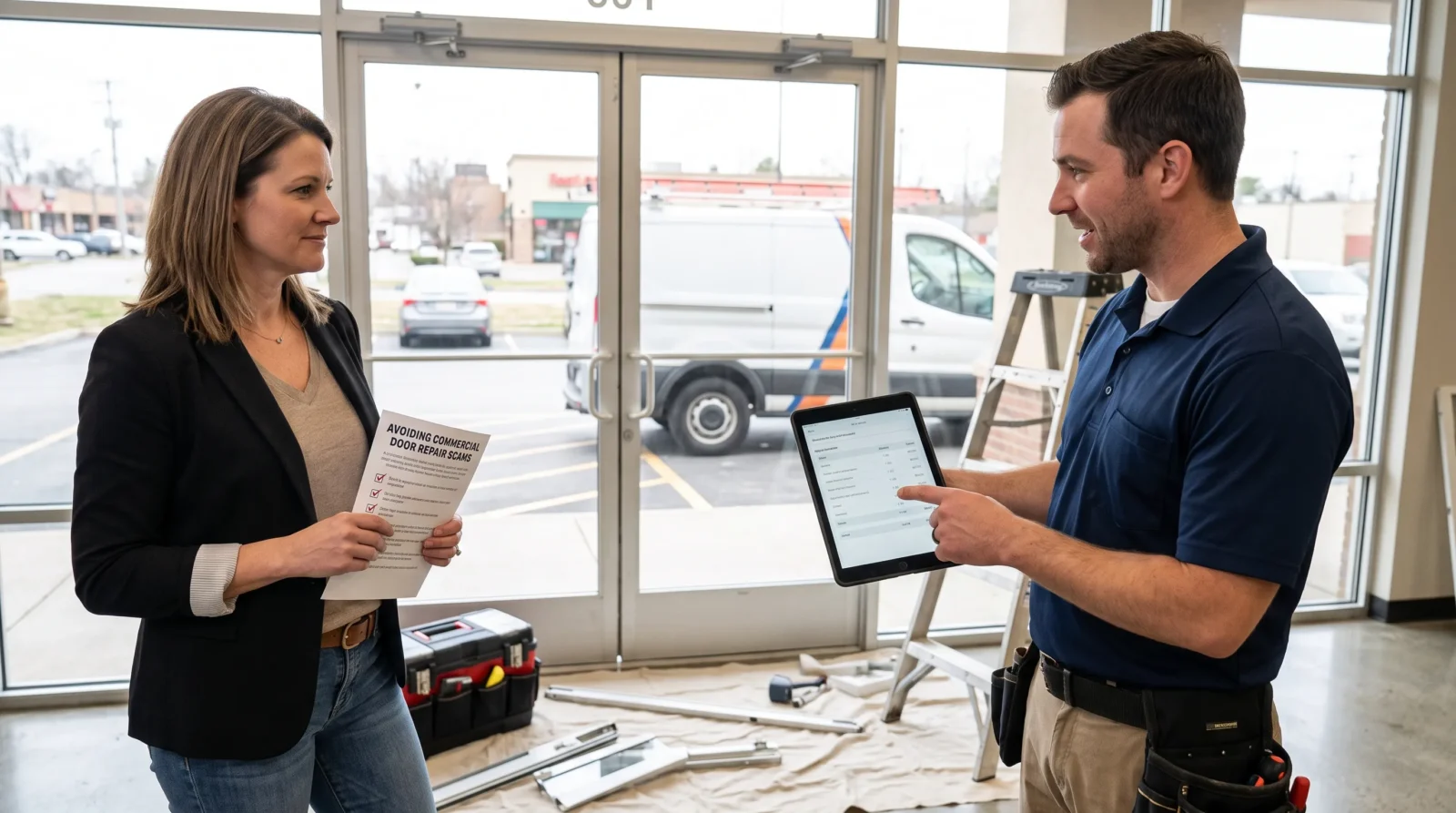
The fastest way to avoid a commercial door repair scam is to require a written, itemized quote before any work begins, and to verify the company’s license, insurance and physical address before the truck rolls. Most scams follow the same pattern: a low phone quote, an urgent on-site diagnosis, and a final bill several times the original number. Legitimate contractors quote in writing, explain what failed and why, offer repair before replacement, and put their warranty on paper. If a technician pressures you to approve major work immediately, that pressure itself is the warning sign.
Key takeaways
- The most common scam is bait-and-switch pricing: a cheap phone quote that multiplies once the technician is on site and the door is disassembled.
- Ask for the license number, a certificate of insurance and a physical business address before scheduling. A company that will not provide all three should not be on your property.
- Get every scope in writing and itemized. Verbal quotes are the single biggest source of billing disputes in commercial door service.
- Most operator and door faults are repairable. A blanket “this whole unit has to be replaced” diagnosis, delivered in the first ten minutes, deserves a second opinion.
- Never approve work under time pressure, and never pay a large cash deposit upfront.
- Springs, counterbalance cables and live operator wiring are not DIY territory on a commercial door. Verification is your job; the repair is not.
Facility managers and business owners are targeted more often than homeowners for one simple reason: the stakes are higher. A jammed dock door stops shipping. A failed storefront door leaves a building unsecured overnight. That urgency is exactly what a dishonest contractor sells against. The ten red flags below are ordered by how often they actually show up, starting with the most common.
1. The price jumps once the technician is on site
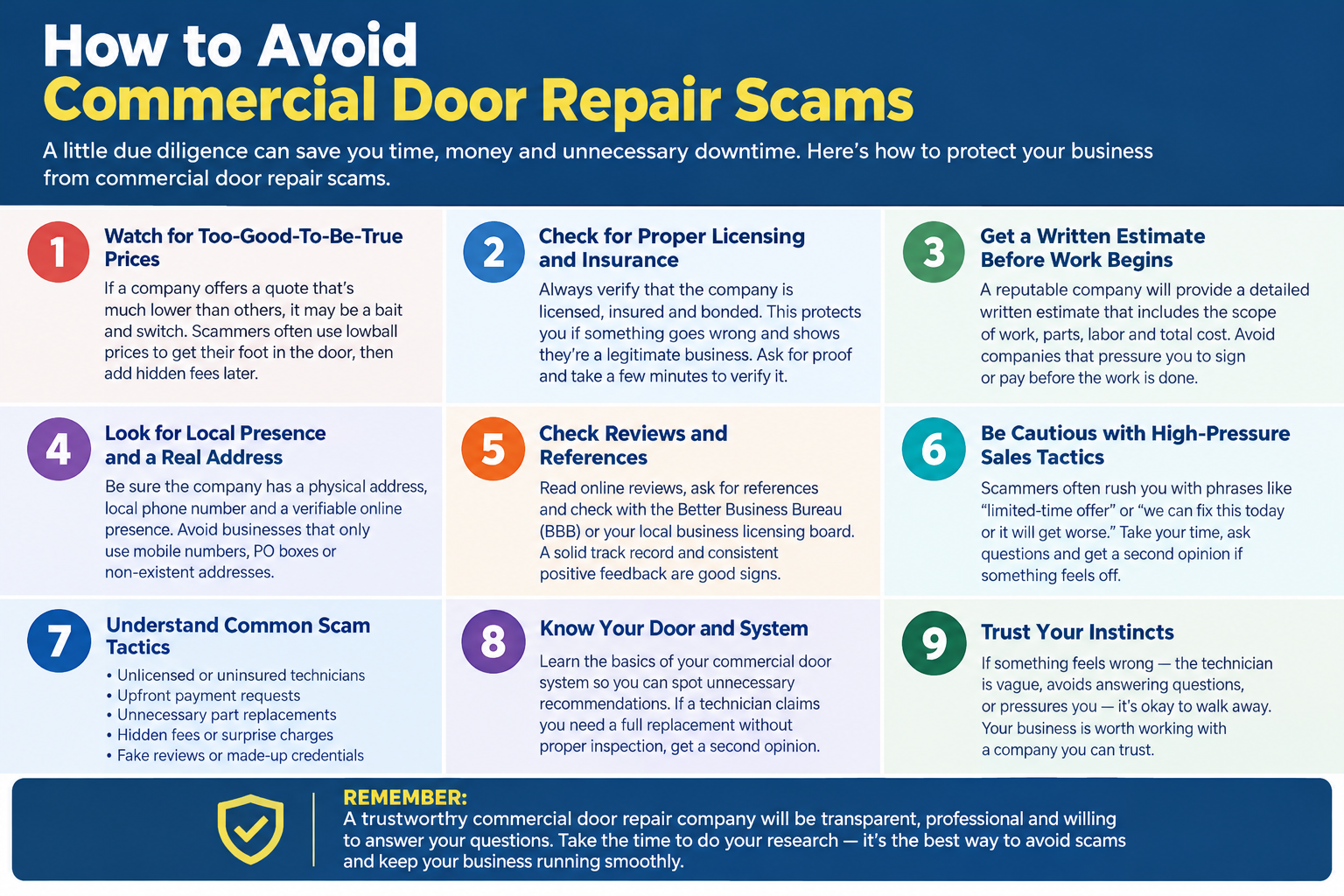
The symptom: you were quoted a low service call over the phone, often suspiciously low. Once the technician arrives and opens the unit, the number climbs to several times the original figure.
Why it happens: the low quote was never meant to be the price. It was the cost of getting a truck into your lot. Once the door is partially disassembled and your operation is stopped, you are negotiating from the weakest possible position.
What to do: treat the phone quote as a service call fee only, and say so out loud when you book. Require that any work beyond diagnosis be quoted in writing and approved by you before it starts. If the number changes on site, ask what specifically was found that the phone quote did not account for. A legitimate answer is specific: a seized bearing, a bent track section, a burned-out control board. A vague answer about “how these usually go” is not an answer.
When a price increase is actually legitimate: genuine hidden damage exists. Water intrusion, impact damage behind a jamb, or a failed component that only shows under load are all real. The difference is that an honest contractor stops, shows you the part, and gets written approval before continuing.
How to spot bait-and-switch pricing in commercial door repair
The tell is sequence, not size. Honest contractors find the problem, stop, explain and re-quote. Scammers find the problem, keep working, and present the number after the fact when refusing costs you more than paying. If a technician has already begun major work before you approved a written price, you are in a bait-and-switch, regardless of whether the final number turns out to be fair.
2. There is no written, itemized scope
The symptom: everything is verbal. You get a total, not a breakdown. The invoice, when it arrives, says something like “door repair” with a single figure.
Why it happens: an itemized scope is a record. Without one, there is no way to dispute a charge, no way to compare bids, and no way to prove what was promised.
What to do: require an itemized quote listing parts, labor hours, trip or dispatch charges, and any after-hours or emergency rate before work begins. Ask specifically whether the quote includes disposal, freight for special-order parts, and a return trip if the part is not on the truck. Those three line items are where surprise charges hide most often.
When verbal is acceptable: never, for planned work. For a genuine after-hours emergency, a verbal authorization with a written follow-up the next business day is reasonable. Get the technician’s name and a rough not-to-exceed figure on the phone, and confirm it by email the same night.
Why a written commercial door repair quote protects your property
A written scope does more than prevent overbilling. It establishes what condition the equipment was in, what was replaced and when, which matters for warranty claims, insurance, and the next contractor who touches the door. Facilities that keep written service records spend measurably less over the life of a commercial door than facilities that do not, because recurring faults get caught as patterns instead of treated as one-offs.
3. Everything needs replacing and nothing can be repaired
The symptom: within minutes of arriving, the technician tells you the operator, the door, or both must be replaced entirely. There is no discussion of repair.
Why it happens: replacement is where the margin is. A control board or a set of rollers is a small ticket. A full unit swap is a large one.
What to do: ask what specifically failed and whether that component is available separately. Most commercial door faults trace to a handful of serviceable parts: rollers, hinges, bearings, the control board, limit switches, contactors, photo eyes and the chain or belt drive. Ask the technician to show you the failed part. Ask for the diagnosis in writing. Then get a second opinion before authorizing a replacement.
When replacement is the honest call: it does happen. Obsolete equipment with no parts support, a door with structural damage across multiple sections, an operator that has been rebuilt repeatedly, or equipment that no longer meets current safety requirements are all legitimate replacement cases. An honest contractor will explain why repair is not viable and will usually still quote both options.
How to tell if your commercial door operator really needs replacing
The question of whether to fix or swap a commercial motor operator is where the most money is lost to unnecessary work. The rule of thumb is repair frequency, not age. A ten-year-old operator serviced twice in a decade is worth repairing. A four-year-old operator on its fourth service call in a year is telling you something. We cover the specific warning signs in Should I Repair or Replace My Commercial Door Operator? 6 Signs You’re Being Upsold.
4. No license, no insurance, no verifiable address
The symptom: unmarked truck, no uniform, no company name on the paperwork. When you ask for a license number or certificate of insurance, you get deflection.
Why it happens: operating without insurance is cheaper. If an uninsured worker is injured on your property, or damages your building, the liability can land on you.
What to do: ask for three things before scheduling: the license or registration number, a certificate of insurance naming your property, and a physical business address you can verify. Call the number on the certificate to confirm the policy is active. Search the business address and check whether it is a real facility or a mail drop. This takes about ten minutes and prevents the large majority of contractor fraud.
When to make an exception: there is not one. For commercial property, an uninsured contractor is an unacceptable risk regardless of price. The International Door Association’s scam awareness resources go into detail on how fraudulent operators construct a legitimate-looking front, and the patterns they describe apply directly to commercial work.
What to verify before hiring a commercial door contractor
Verification is a short checklist, not an investigation. License, insurance, physical address, manufacturer authorization, and references from facilities comparable to yours. Work through it once and you will never repeat this particular mistake. The full checklist is in How Do I Know If a Commercial Door Company Is Legit? 8 Things to Check Before You Call.
5. You are pressured to decide immediately
The symptom: the price is only good today. The part is the last one. The technician needs an answer before he leaves the lot.
Why it happens: urgency defeats comparison shopping. Every minute you spend getting a second quote is a minute the scam can fall apart.
What to do: slow down. Say plainly that you do not authorize work over a set dollar amount without a second quote, and hold that line. If the door is genuinely unsafe or the building is unsecured, authorize only the work needed to make it safe or secure, and defer the rest. That is a reasonable position and a legitimate contractor will accept it without friction.
When urgency is real: a door that will not close on a building holding inventory, a fire-rated door that has failed, or a dock door blocking outbound freight are all genuinely time-sensitive. The difference is that real urgency is about your operation. Manufactured urgency is about their price expiring.
Why high-pressure commercial door repair tactics are a warning sign
Pressure exists to prevent verification. Every legitimate step you might take, checking a license, calling for a second quote, reading a written scope, takes time, and time is what a scam cannot afford to give you. Treat any demand for an immediate decision as a reason to slow down rather than speed up.
6. The bill contains charges nobody explained
The symptom: the final invoice includes line items you never heard about. Trip charges, fuel surcharges, after-hours multipliers, shop supplies, environmental fees, or a parts markup that does not resemble any published price.
Why it happens: padding works because most facilities pay invoices through accounts payable, not through the person who was standing at the door. By the time anyone questions a charge, the work is months old.
What to do: ask upfront which surcharges apply and what triggers them. Reconcile the invoice against the written quote before it goes to accounts payable. If a line item is unexplained, ask for the explanation in writing. Legitimate companies answer this question easily because their pricing is structured, not improvised.
When a surcharge is legitimate: after-hours and emergency rates are standard across the industry, as are freight charges on special-order parts. Published, disclosed and consistent is fine. Invented at invoice time is not.
Which commercial door repair charges are worth questioning
Not every unexpected line item is fraud. Some are simply undisclosed. The distinction that matters is whether the charge existed as policy before your job or appeared because of it. We break down the seven most-disputed charges in Why Was My Commercial Door Repair Bill So High? 7 Charges Worth Questioning, including the ones that are normal and the ones that are not.
7. Cash only, or a large deposit upfront
The symptom: the contractor wants cash, a check made out to an individual, or a substantial deposit before any work or materials are ordered.
Why it happens: cash leaves no trail and no chargeback. A large upfront deposit funds the operation and, in the worst cases, is the entire transaction.
What to do: pay by a method that leaves a record and gives you recourse. A deposit on genuinely special-order material is normal and reasonable, typically a portion of the material cost. A large deposit on standard service work is not. Get the deposit terms in the written quote, and never make a check out to a person rather than a business entity.
When a deposit is legitimate: custom or special-order doors, non-stock operators, and large sectional replacements often require material deposits. The tell is documentation. A legitimate deposit is tied to identified material on a written quote.
How to handle deposits and payment for commercial door repair safely
Pay a business, not a person, by a method that creates a record. Tie any deposit to specific material named on a written quote, and hold final payment until the work is complete and the door has been tested in front of you. Those three habits eliminate most payment-side fraud on their own.
8. Generic advertising with no real local presence
The symptom: the company found you through an ad with a generic name, a stock photo and a local-looking phone number. Nothing about it is traceable to an actual business in your area.
Why it happens: some operations run advertising in dozens of markets with no facility in any of them, then sell the lead or dispatch a subcontractor. Nobody involved has a long-term relationship with your building.
What to do: verify the local address, look for reviews that reference real specifics, and ask how long the company has served your area. Ask who will actually perform the work, the company you called or a subcontractor. For commercial overhead door work, a contractor with a real local facility also means real parts inventory, which is the practical difference between same-day service and a week of downtime.
When a national or franchise operation is fine: plenty of legitimate companies operate across multiple markets. The question is not reach, it is whether there is an accountable local branch with a verifiable address and a service history in your area.
Why a local commercial door repair company matters for response time
Local presence is not sentiment, it is logistics. A contractor with a nearby facility carries rollers, hinges, sensors, boards and common operators in stock, which is the difference between a door back in service the same day and a door waiting on freight. Ask what they stock locally for your make and model.
9. Your equipment is declared obsolete without evidence
The symptom: the technician says parts are no longer available for your brand, or that your equipment is too old to service, and moves directly to a replacement quote.
Why it happens: most facility managers cannot independently verify parts availability, which makes this claim easy to make and hard to check.
What to do: get the make, model and serial number off the data plate before the conversation goes further. Photograph it. Manufacturer support for commercial equipment often runs far longer than for residential products, and aftermarket parts frequently exist even where original parts do not. Manufacturer resources such as Clopay’s guidance on spotting door repair scams describe this same tactic, and the check is straightforward: confirm parts availability yourself, or through a second contractor, before accepting the diagnosis.
When obsolescence is real: it genuinely happens with discontinued lines, especially older control systems where boards are no longer produced and safe substitutes do not exist. A contractor making this claim honestly can name the manufacturer, the discontinuation, and what they tried to source.
How to check whether commercial door parts are really unavailable
Start with the data plate. Make, model and serial number give you everything needed to check parts support directly with the manufacturer or through a second contractor. Photograph the plate before any conversation about replacement, because once equipment is removed, verifying the claim becomes much harder.
10. No written warranty
The symptom: you ask what is covered and for how long, and the answer stays verbal, vague, or shifts between conversations.
Why it happens: a written warranty is a commitment that outlasts the transaction. An operation that does not expect to be reachable in six months will not put one in writing.
What to do: get the warranty in writing before work starts, covering both parts and labor, with the durations stated separately. They are often different. Confirm what voids it. Keep it with your service records.
When a limited warranty is reasonable: warranties on customer-supplied parts, on temporary repairs you specifically requested, or on equipment already at end of life are legitimately limited. That is honesty, not evasion, as long as it is stated in writing upfront. Ongoing commercial door service agreements typically spell this out clearly, which is one of their underrated advantages.
What a commercial door repair warranty should cover in writing
Look for four things stated separately: the parts coverage period, the labor coverage period, what specifically is excluded, and what voids the coverage. If any of the four is missing, the warranty is not really a warranty. Keep the document with your service records so the next technician can see it.
What you can safely check yourself, and what needs a technician
Verification is yours. Repair is not. Commercial door systems store enormous energy in the counterbalance assembly, and the operators run on live three-phase or high-voltage single-phase power.
Task | Safe to do yourself | Call a qualified technician |
Verifying license, insurance and address | Yes | No |
Reading the data plate for make, model and serial | Yes | No |
Photographing damage and keeping service records | Yes | No |
Clearing debris from the track path and threshold | Yes | No |
Wiping and realigning photo eye sensors | Yes, if surface-level only | If realignment does not restore function |
Testing the auto-reverse safety function | Yes | If the door fails the test, stop and call |
Resetting a tripped breaker once | Yes | If it trips again, stop and call |
Adjusting or replacing counterbalance springs | Never | Always |
Replacing or tensioning lift cables | Never | Always |
Any work inside the operator housing or wiring | Never | Always |
Adjusting limit switches or travel settings | Never | Always |
Repairing or realigning bent track or hinges | Never | Always |
Any work on a fire-rated door assembly | Never | Always, with documented testing |
Two hard rules. Do not work on springs or cables under any circumstances, on any commercial door. And do not disable a safety sensor to keep a door running through a shift. If a door is failing its safety functions, take it out of service until it is repaired. Using the emergency release on a commercial overhead door is the correct interim step when a door must be moved manually, and there is a right and a wrong way to do it.
Protecting your property starts before the truck arrives
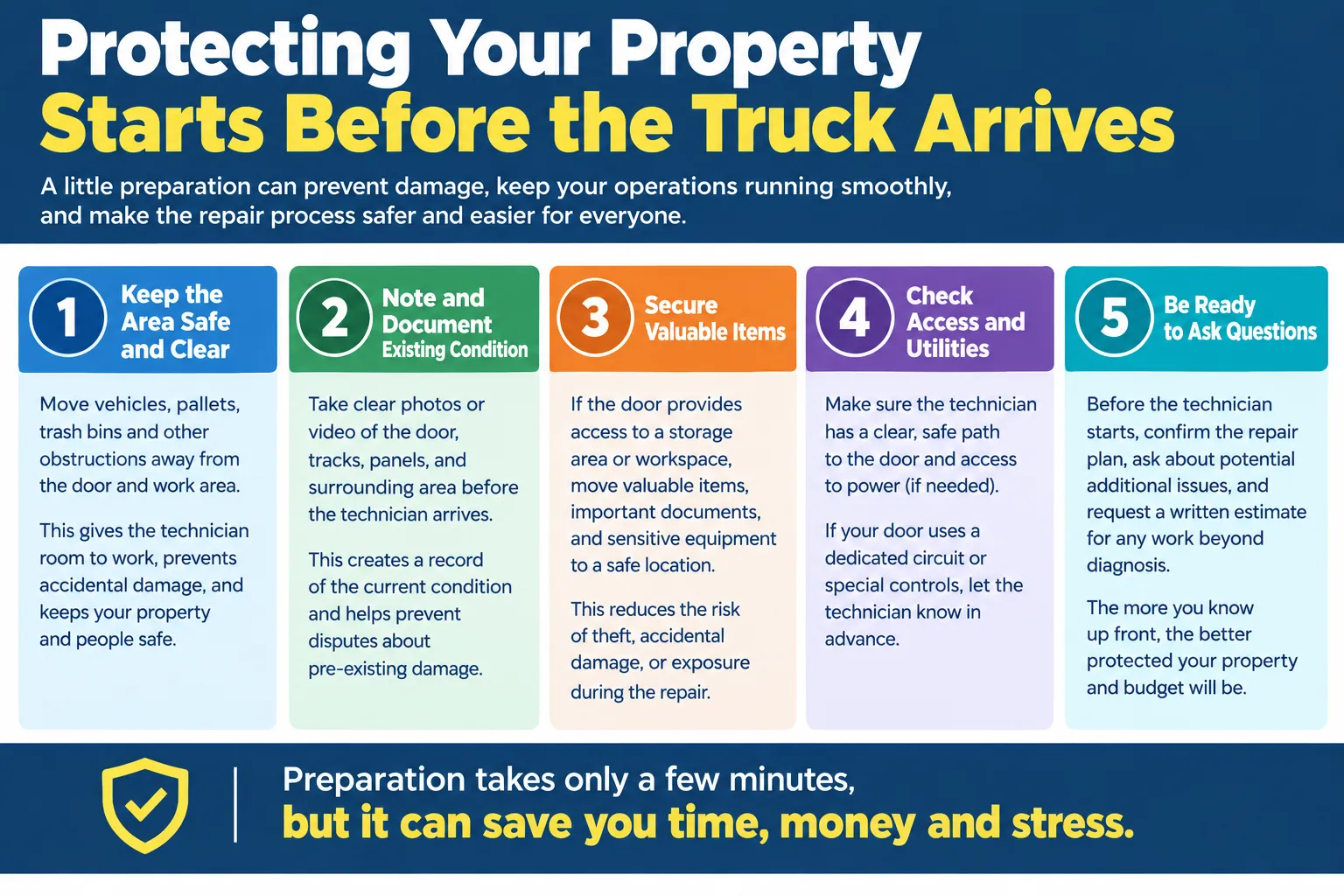
Almost every commercial door repair scam depends on the same conditions: no written scope, no verified credentials, and a decision made under pressure. Remove those three and the tactics in this guide stop working. Ask for the license and certificate of insurance. Require the quote in writing and itemized. Refuse to authorize major work without a second opinion. None of that is adversarial, and no legitimate contractor will resist it.
It is also worth understanding what causes frequent commercial door repair issues in the first place, because a facility on a real maintenance schedule spends far less time in emergency calls, which is exactly where overcharging happens. The same logic applies to preventing downtime through planned commercial door repair. If you are unsure whether a job warrants a professional at all, the signs you need to hire a pro for commercial door repair are a useful starting point. Industry groups track these schemes closely, and recent industry warnings from the International Door Association reflect how persistent they remain.
If you manage a commercial property in Central Texas and want a contractor who quotes in writing, carries verifiable license and insurance, and repairs before recommending replacement, R&S Overhead Garage Door of Texas, Inc. serves Travis, Hays, Burnet and Bastrop counties with licensed commercial door technicians and stocked local inventory.
Request a free written quote for your commercial door service and get an itemized scope before any work begins.