
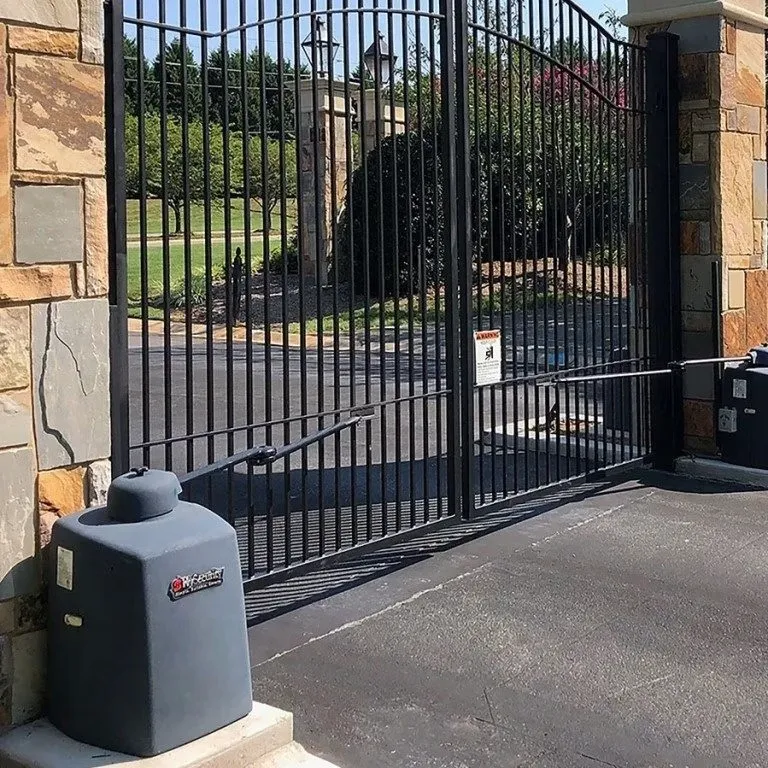
Automatic swing gates are one of the most popular gate styles in Austin, TX. Whether the property is off Heatherwilde Boulevard, near Stone Hill Town Center, or out toward the newer developments on the east side of town, these gates are showing up on more driveways every year.
This guide breaks down exactly how automatic swing gates work, what parts are involved, what can go wrong, and how to keep the system running strong in Central Texas heat, all in plain and simple language.
What Is an Automatic Swing Gate?
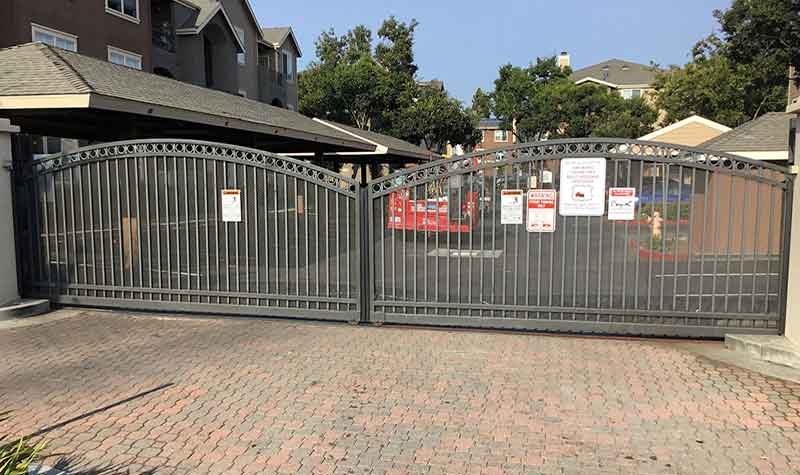
An automatic swing gate opens and closes by swinging on hinges, just like a regular door, except it is powered by an electric motor instead of being hand-operated. It can swing inward toward the property or outward toward the street, depending on the driveway layout.
These gates come in two main configurations:
- Single-leaf – One gate panel that swings to one side
- Dual-leaf – Two panels that open from the center, similar to double doors
Both styles are widely used across Austin residential and commercial properties. Dual-leaf gates work better on wider driveways where a single panel would need to swing too far out to be practical.
Curious about what actually powers the movement behind these gates? Check out “What Powers an Automatic Swing Gate?” for a deeper look at the motor systems that make it all happen.
The 7 Key Parts That Make an Automatic Swing Gate Work
Every automatic swing gate system is made up of several components working together. When one part fails, the rest of the system feels it.
1. The Gate Operator – The Engine Behind Every Movement
The gate operator is the motor unit that physically moves the gate. Without a functioning operator, the gate simply will not move.
There are two main types:
- Articulated Arm Operator – A mechanical arm connects the motor to the gate panel. When the motor activates, the arm pushes the gate open, then pulls it closed. This is the most common type found on Austin residential properties.
- Underground (In-Ground) Operator – The motor is buried beneath the gate post inside a sealed housing. No visible mechanical arm means a much cleaner look. These are popular on high-end custom homes where curb appeal is a priority.
Expert Tip: Austin summers are brutal, and underground operators are vulnerable to heat buildup and moisture if the housing is not properly sealed. Always confirm the installer uses a housing unit rated for high-temperature environments.
Before choosing an operator type, it is worth knowing how these systems hold up when it comes to safety. Read “Are Automatic Swing Gates Safe for Driveways?“ to understand what safety features to look for before making a decision.
2. The Control Board – The Brain of the Operation
The control board is the electronic circuit board that serves as the decision-maker for the entire system. It receives signals from remotes, keypads, and sensors, then tells the motor what to do and when to do it.
Modern control boards handle:
- Open and close speed settings
- Auto-close timers
- Obstruction detection responses
- Dual gate panel synchronization
- Remote and keypad access code storage
What to watch for: A gate that reverses for no clear reason, opens partially, then stops, or stops responding to the remote is often pointing to a control board issue. Have a qualified technician diagnose it first because sometimes it is nothing more than a loose wire rather than a full board replacement.
If the property sees a lot of daily vehicle activity, the control board is just one part of the equation. Find out more in “Can Automatic Swing Gates Handle Heavy Traffic?“ to see how the full system performs under high-demand conditions.
3. Safety Sensors – The Feature That Protects People and Property
Photocell safety sensors shoot an invisible infrared beam across the gate opening. If anything breaks that beam while the gate is closing, the gate immediately stops and reverses. In a community like Austin, where neighborhoods are full of children and pets, properly functioning sensors are not optional.
Common Problem: Sensors sit low to the ground and deal with Texas dust, fire ant activity, and spider webs regularly. Any of these can block the sensor beam and cause erratic gate behavior.
Quick Check: Most operators have an indicator light dedicated to sensor status. If that light is blinking or off, start by cleaning the sensor lenses with a dry cloth and confirming both units are pointing directly at each other. Many service calls turn out to be nothing more than a dirty sensor lens.
4. The Gate Arm and Hinge System – Where Power Meets the Panel
The gate arm transfers all of the motor’s power directly to the gate panel. On articulated arm systems, it extends as the gate opens and folds as it closes.
The hinges carry the full weight of the gate every single time it moves. Loose or worn hinges put enormous stress on the operator motor, forcing it to work harder than it was designed to handle and leading to premature failure.
Expert Tip: Metal expands and contracts with temperature changes, and Austin sees plenty of both extremes across the seasons. Hinge bolts can loosen over time from that repeated cycle. A quick bolt check during routine maintenance can prevent a sagging gate from turning into a full operator replacement.
5. Power Supply and Battery Backup – Keeping the Gate Running No Matter What
Most residential swing gates run on standard 120-volt household electricity. However, Texas is no stranger to power outages from storms and extreme weather. A quality gate system should include a battery backup so the gate stays operational even when the power goes out.
What to check: Backup batteries typically last 3 to 5 years. If the gate stops working during an outage or behaves sluggishly when the power is on, a degraded battery could be the cause. Replacing the battery is a straightforward job with a modest average cost, far less stressful than being locked outside during a Texas thunderstorm.
6. The Access Control System – How the Gate Gets the Signal to Open
The access control system is the interface between the people who need entry and the gate itself. Common options include:
- Remote Controls and Key Fobs – The most widely used option. Press a button, the signal hits the receiver on the control board, and the gate opens.
- Keypads – Allow entry using a PIN code. Ideal for housekeepers, contractors, and regular guests who need access without a physical remote.
- Vehicle Loop Detectors – Sensors embedded beneath the pavement that detect a vehicle’s metal mass. Most commonly used on the exit side, so the gate opens automatically as a vehicle approaches from inside the property.
- Video Intercoms – Visitors press a call button, the homeowner sees and speaks to them through a smartphone app, and can unlock the gate remotely from anywhere.
Austin Tip: A popular local setup is a video intercom plus keypad on the entry side combined with a loop detector on the exit side. Secure entry, seamless exit, no remote required on the way out.
7. Limit Switches – Teaching the Gate When to Stop
Limit switches tell the motor to stop once the gate reaches its fully open or fully closed position. Without them, the motor would keep running past the travel range and cause serious mechanical damage.
On modern operators, limits are set electronically during installation. On older systems, physical switches may be located inside the operator housing.
What can go wrong: A gate that slams hard at the end of its travel or stops short of fully closing likely has limit settings that are off. A qualified technician should handle this adjustment since incorrect limits cause accelerated wear on the motor, arm joints, and hinges.
How the Entire System Works Together
Here is what happens in the few seconds between pressing a remote and the gate swinging open:
- The remote button is pressed, and a radio signal is sent to the control board receiver
- The control board sends power to the gate motor
- Motor drives the gate arm, pushing the gate panel along its hinge arc
- Photocell sensors activate and monitor the opening for obstructions
- The gate reaches the programmed open limit, and the motor stops
- Auto-close timer counts down on the control board
- The control board signals the motor to reverse
- The gate swings closed and stops at the programmed closed limit
Every step depends on the one before it. That is why even something as minor as a dirty sensor lens can affect the performance of the entire system.
Common Problems and What Homeowners Can Check
- Gate will not open or close – Check that the operator has power, confirm the circuit breaker has not tripped, and try a fresh remote battery.
- Gate reverses before fully closing – Clean the photocell sensor lenses, check alignment, and look for any objects in the gate’s path.
- Gate moves slowly or struggles – Hinges likely need lubrication, or the motor is being overworked. Have a technician inspect before the motor burns out.
- Gate opens but never auto-closes – Check whether the auto-close timer is enabled on the control board. A sensor stuck in obstruction mode can also prevent the closed cycle from starting.
Important: Homeowners can safely clean sensors, lubricate hinges, and replace remote batteries. Anything involving the motor, wiring, or control board should be handled by a licensed gate technician. DIY electrical repairs can void the system warranty and create real safety risks.
Maintenance Tips for Austin Homeowners
- Lubricate hinges and arm pivot points every 6 months using silicone-based or lithium-based grease
- Clean photocell sensor lenses monthly – spider webs and fire ant activity around sensor housings are surprisingly common causes of gate malfunctions in Texas.
- Test the battery backup every year, ideally before spring storm season
- Inspect and tighten hinge bolts twice a year to account for metal expansion from temperature swings
- Trim vegetation around the gate path to prevent sensor interference and obstruction of the swing arc
- Schedule a professional inspection once a year to catch worn components before they cause a full breakdown. This applies whether the property has a swing gate, a sliding gate, or a tilt gate installed
Trusted Local Experts Ready to Help
R&S Overhead Garage Door of Texas, Inc. has been serving Austin and the surrounding Central Texas area with reliable gate and garage door services that homeowners can count on. From routine maintenance to full operator replacements, our team brings hands-on expertise that gets the job done right the first time. Do not wait for a small issue to turn into a costly repair. Contact us today or give us a call to schedule a service visit and keep your automatic swing gate running smoothly all year long.